



Background
Physical activity is important for health. Specifically, Moderate-to-vigorous physical activity (MVPA) is linked to a range of health outcomes and are incorporated in international guidelines.
Despite its importance, moderate to vigorous physical activity (MVPA) is typically much lower than recommended in children and adolescents globally, from age 3-4 years and across childhood and adolescence 1,2.
A belief that MVPA is adequate in children but declines during adolescence, has resulted in policy and practice effort being directed at adolescence.

Findings
- A systematic review of a large body of UK and international accelerometer-studies which measured MVPA in the same child over time (longitudinal) found that the decline in MVPA started well before adolescence, at similar rates in both boys and girls 3.
- A large body of UK and international cross-sectional (different children measured at different ages) accelerometer studies showed that the decline in MVPA started by around age 5 and was similar in both boys and girls; light intensity physical activity and MVPA was displaced by increasing sedentary time as children got older 4.
- A systematic review of accelerometer measured sedentary behaviour (sitting) found that it increased year on year as children get older from aged 4, by about 20-30 minutes per day per year in the UK and globally5,6, displacing physical activity initially and displacing sleep later in childhood and adolescence 7.

Why This Matters
Adolescent girls are not at especially high risk of low MVPA. While more adolescent MVPA would be a good thing, the evidence is clear that it is never too early to promote MVPA. Increasing screen time year on year across childhood and adolescence is displacing MVPA and sleep, establishing a habit of low MVPA well before adolescence.
Early and mid-childhood screen time has had negligible health or education policy attention in Scotland to date10. We have a crisis of low MVPA in children and adolescents, with devastating and enduring consequences for their physical and mental health and wellbeing, their brain development and educational attainment, and planetary health 2, 9, 10.
Resources to promote MVPA in Scotland have been limited. Substantial MVPA promotion is required across childhood and adolescence if the crisis of low MVPA is to be addressed, and this is likely to require greater capacity and greater resource.
Public health surveillance (monitoring) of physical activity and screen time exists but is very limited in Scotland 11. MVPA surveillance means national accelerometer surveys of the kind common in many other countries.
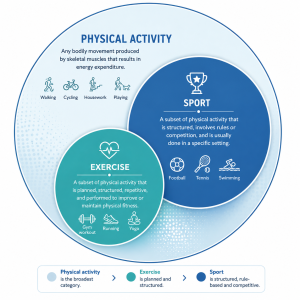
Tackling adolescent declines in sport participation is worthy but this is not the same as tackling low MVPA – time spent in sport is a small subset of time spent in MVPA.

- Physical activity policy and practice in Scotland should pivot- focusing more on early life, and on reducing screen time to promote physical activity.
- It is never too early to promote physical activity– evidence-based guidelines for physical activity, screen time and sleep are available from birth.
- Physical activity promotion should not solely focus on sport, but cover a range of behaviours and activities that contribute to MVPA in children and adolescents.
References
1 Chong KH, et al., (2024). Pooled Analysis of Physical Activity, Sedentary Behavior, and Sleep Among Children From 33 Countries. JAMA Pediatr. 1;178(11):1199-1207. .
2 Aubert, S., et al., (2022). Global Matrix 4.0 Physical Activity Report Card Grades for Children and Adolescents: Results and Analyses From 57 Countries. Journal of Physical Activity and Health, 19(11), 700-728., from https://doi.org/10.1123/jpah.2022-0456
3 , , , et al. Longitudinal changes in moderate-to-vigorous-intensity physical activity in children and adolescents: A systematic review and meta-analysis. Obesity Reviews. 2020; 21:e12953. https://doi.org/10.1111/obr.12953
4 Cooper, A.R., Goodman, A., Page, A.S. et al. Objectively measured physical activity and sedentary time in youth: the International children’s accelerometry database (ICAD). Int J Behav Nutr Phys Act 12, 113 (2015). https://doi.org/10.1186/s12966-015-0274-5
5 Tanaka, C., Reilly, J.J. and Huang, W.Y. (2014). Changes in children sedentary behaviour. Obes Rev, 15: 791-803. https://doi.org/10.1111/obr.12195
6 Janssen, X., Mann, K.D., Basterfield, L. et al., (2026). Development of sedentary behavior across childhood and adolescence: longitudinal analysis of the Gateshead Millennium Study. Int J Behav Nutr Phys Act 13, 88. https://doi.org/10.1186/s12966-016-0413-7
7 Reilly, J.J. (2016). When does it all go wrong? Longitudinal studies of changes in moderate-to-vigorous-intensity physical activity across childhood and adolescence, Journal of Exercise Science & Fitness, Volume 14, Issue 1, Pages 1-6, https://doi.org/10.1016/j.jesf.2016.05.002.
8 De Craemer M, Veldman S, Azevedo L et al. Practical steps needed to achieve impact of the WHO 2019 movement behaviour guidelines for children under the age of 5: the SUNRISE Study Europe Group evaluation
The Lancet Regional Health – Europe, 2024; 39. DOI: 10.1016/j.lanepe.2024.100869
9 U.S. Department of Health and Human Services (2018). Physical Activity Guidelines for Americans, 2nd edition. Washington, DC: U.S. Department of Health and Human Services.
10 Salvo, D., et al. (2021). Physical Activity Promotion and the United Nations Sustainable Development Goals: Building Synergies to Maximize Impact. Journal of Physical Activity and Health, 18(10), 1163-1180. Retrieved Jul 29, 2026, from https://doi.org/10.1123/jpah.2021-041.
11 Bardid F, Tomaz SA, Johnstone A, Robertson J, Craig LCA, Reilly JJ. Results from Scotland’s 2021 report card on physical activity and health for children and youth: Grades, secular trends, and socio-economic inequalities. J Exerc Sci Fit. 2022;20(4):317-322. doi:10.1016/j.jesf.2022.07.002