


 Movement behaviours in the under 5s
Background
Evidence based national guidelines on time spent in Physical Activity, Screen-Time and Sleep have been available from 2017 (Canada, Australia, New Zealand) and international guidelines from 2019 (WHO). These guidelines showed the following for the Under 5s:
- More physical activity is better for body fatness, cognitive development, physical fitness, bone health, cardiometabolic risk factors.
- More sleep is better for body fatness, emotional regulation, cognitive development.
- Less screen time is better for body fatness, motor development, cognitive development, psychological health and wellbeing 1.
Physical Activity, Screen Time and Sleep have long been recognised as important drivers of childhood obesity- they both cause and maintain obesity by various well established mechanisms. The evidence and science on this topic have been settled for decades for screen time and physical activity, e.g. since SIGN Guidelines on Obesity in 2003 and 2010, and more recently for sleep.
These three ‘movement behaviours’ in early life were central to recommendations in the WHO Ending Childhood Obesity Report in 2016 and the WHO Ending Childhood Obesity Report Implementation Plan in 2017 and led to development of the WHO Guidelines on Physical Activity/Screen Time/Sleep in the Under 5s in 2019.
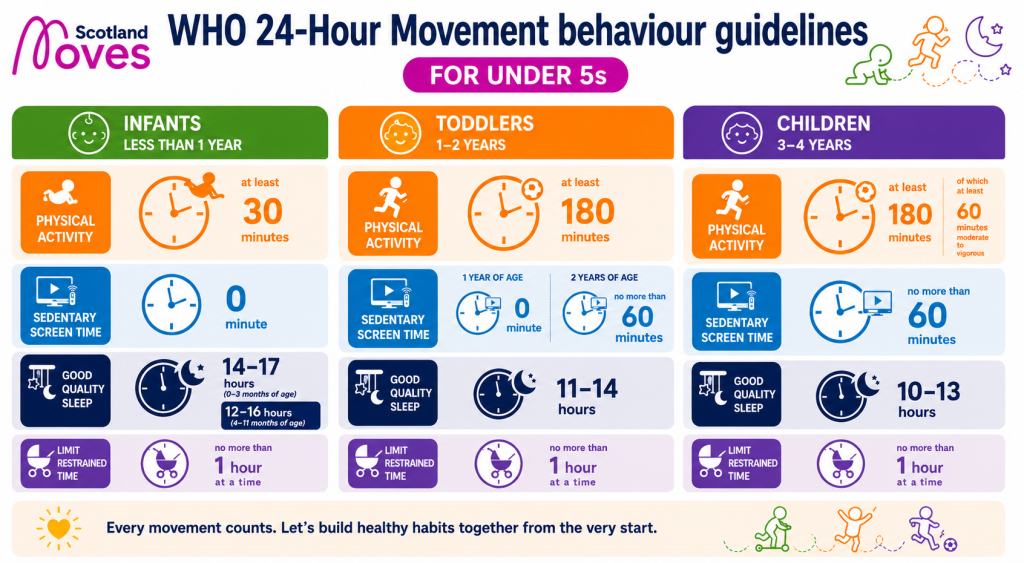
Screen Time and Sleep in early life have not been a significant part of Scottish health policy, past or present. Lack of policy in these topics has not been due to lack of science or evidence, but possibly due to some combination of lack of advocacy or awareness or resources, limited surveillance, policy inertia, and/or reluctance to address vested interests in screen time.

Findings
- Screen time is now too high and MVPA too low (compared to guidelines) in children and adolescents in the UK and globally, from age 3-4 years and across childhood and adolescence2,3.
- A recent synthesis of evidence on the factors determining Early Childhood Development (ECD) concluded that the ‘next thousand days’ (age 2-4 years) was critical to successful ECD, and that ECD was influenced critically by Physical Activity/Screen Time/Sleep4.
- WHO has published useful guidance on how to achieve better Physical Activity/Screen Time/Sleep in the Under 5s.
- Recent Scottish Health Policy has negligible focus on Screen Time/Sleep in the Under 5s.
- The SUNRISE International Study Europe Group (sunrisestudy.org) published recommendations on how to incorporate WHO 2019 Guidelines nationally and across Europe – figure–their recommendations go well beyond simply producing
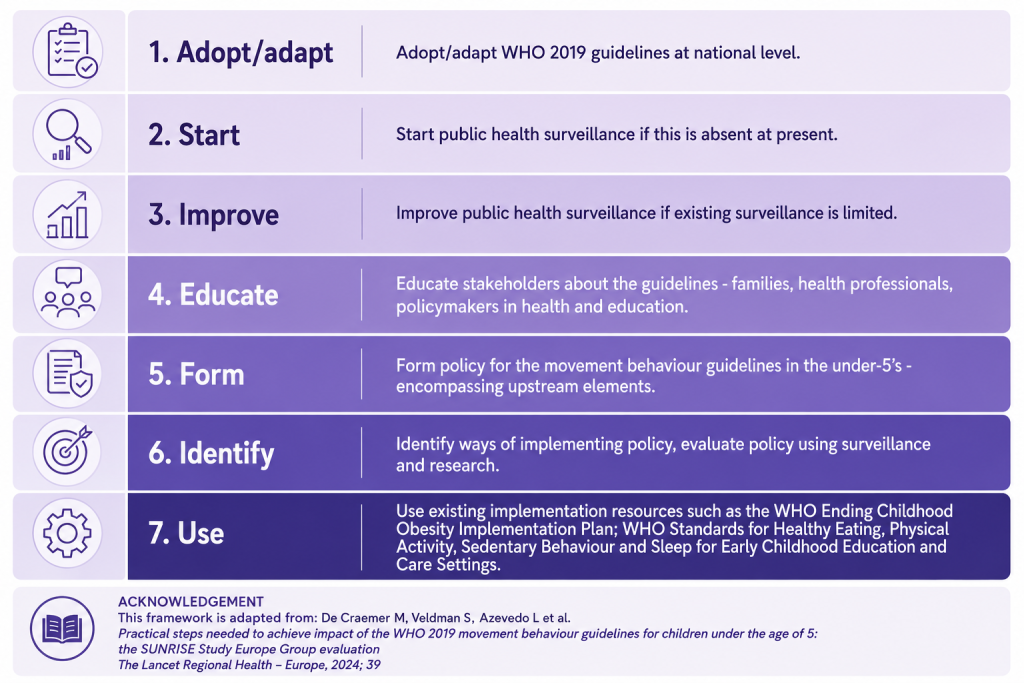 guidelines included-suggest reusing or redrawing the figure from this paper.
 - The most recent Active Healthy Kids Scotland Report Card (number 6, 2026) found substantial gaps in public health surveillance of Physical Activity/Screen Time/Sleeep in the Under 5s in Scotland- this results in a lack of visibility and that tends to mean lack of public health action.

Why This Matters
Physical and mental health, ECD and educational attainment, and reducing socio-economic inequalities in these outcomes will all benefit from a focus on Physical Activity/Screen Time/Sleep in the Under 5s.
Pandemic preparedness will benefit from healthier levels of early life Physical Activity/Screen Time/Sleep in the Under 5s.
Physical activity in the Under 5s occurs mainly in the form of Play – the UNCRC right to play is being denied by excessive screen time.
A greater focus on screen time is timely. Many stakeholders and NGO stakeholder organisations have been expressing increased concern over screen time harms in Scotland recently. Addressing screen time in the Under 5s in policy and practice in Scotland would be responsive to those serious concerns – much of the public discourse has related to social media and adolescents, but screen time in the Under 5s is a neglected opportunity in Scottish public health.

- Addressing Physical Activity/Screen Time/Sleep in the Under 5s should start with incorporation of the WHO Guidelines for the Under 5s and extend to sharing the guidelines with a wide range of stakeholders across Scotland, and updating guidelines periodically.
- Future Scottish health policy should focus on the Under 5s, and have much greater emphasis on Physical Activity/Screen Time/Sleep, and much greater emphasis on policy implementation, pan-European and WHO guidance on how to do this is available.
- Better data means better public health. Improving our public health surveillance (monitoring) of Physical Activity/Screen Time/Sleep in the Under 5s will allow us to develop informed ways to improve those health behaviours, improve ECD and educational attainment, and reduce socio-economic inequalities in health and educational attainment.
References
1 Reilly, J.J., et al. (2020). GRADE-ADOLOPMENT Process to Develop 24-Hour Movement Behavior Recommendations and Physical Activity Guidelines for the Under 5s in the United Kingdom, 2019. Journal of Physical Activity and Health, 17(1), 101-108. Retrieved Jul 29, 2026, from https://doi.org/10.1123/jpah.2019-0139
2 Chong KH, et al. (2024). Pooled Analysis of Physical Activity, Sedentary Behavior, and Sleep Among Children From 33 Countries. JAMA Pediatr. 2024 Nov 1;178(11):1199-1207. doi: 10.1001/jamapediatrics.3330.
3 Aubert, S., et al., (2022). Global Matrix 4.0 Physical Activity Report Card Grades for Children and Adolescents: Results and Analyses From 57 Countries. Journal of Physical Activity and Health, 19(11), 700-728., from https://doi.org/10.1123/jpah.2022-0456
4 Draper C, Yousafzai A, McCoy D et al.(2024). The next 1000 days: building on early investments for the health and development of young children, The Lancet: 404, 2094-2116. DOI: 10.1016/S0140-6736(24)01389-8